Sunday, March 23, 2014

How to get started with a new garden


For all people who sit on a block of earth, no matter how small it may be, and who are thinking about starting to produce food and veggies, the actual start might be a bit daunting. Making the most out of your space with the right motivation is a big goal, but making a small start is easy. Here are my suggestions based on my own journey.

1. Permaculture is a system about designing your garden that works and meets your needs as well as the needs of this earth. On the Permaculture WA website you find very useful info sheets on how permaculture works. I suggest you start by reading this one http://permaculturewest.org.au/resources/pw-principles-of-permaculture.pdf which gives you a good overview of the design principles and how it all comes together; or watch the video http://permaculturewest.org.au/resources/what-is-permaculture. To get more detailed knowledge you might want to sign up to a relevant course about permaculture http://permaculturewest.org.au/resources/education and then get the right system in place that match your location and your personal needs.
2. Improving the soil is imperative if you are on a sandy patch like most locations in Perth. Our suggestions are available here http://permaculturewest.org.au/resources/pw-soil-building.pdf

3. For getting good seeds you might want to contact Environment House in Bayswater http://www.envirohouse.org.au/ , also check out businesses linked to Permaculture West
http://permaculturewest.org.au/resources/businesses, try your local organic food store or check out the GreenLife Soil Company http://www.greenlifesoil.com.au/seeds.htm, a good address for your gardening needs. PermacultureWest has seedsaver groups which you might want to join. More info here: http://permaculturewest.org.au/community/seed-saving-wa
4. Learn from the experts. The Perth Gardening Show is coming up shortly. Attend it and have a look at the opportunities available, from 3-6 April, more info here: http://perthgardenfestival.com.au/
5. Finally talk to your gardening friends and invite them to come to your house for a chat and a site inspection. Rather focus on a few little projects now and get their help in putting them into reality. 

6. Get yourself a few good gardening books. My favourite ones are:
 - Lolo Houbein - One Magic Square
- Readers Digest - Grow your own Fruit and Vegetable the easy way for Australia and New Zealand
Or simply start with the gardening books you already have at your home.
If you are interested in joining a Permaculture West local group, just select the one that you feel closest to from the choice here: http://permaculturewest.org.au/community/local-groups.

Best of luck and let me know how you went.

Tuesday, November 26, 2013

Broody hens - what now?


The hens have made a good start. They settled in well and were producing an astonishing four eggs a day. I have identified which egg belongs to what hen.The brown eggs are laid by the hens without a comb. The small egg to the top left was the first one produced by the boss hen after she went through a period of about three weeks being broody. During this time she was pestering the other three chooks with the result that production of eggs was down. The three pictures were taken on 3rd, 4th and 5th November 2013.
The chooks look quite similar, but the eggs look so different. Does this mean they come from different races. The combs give it away, two have a short one and two have long combs. I think these are (mainly) Light Sussex hens.

The home made nesting box was clearly too big for the Isa Brown. These hens fit in well. The two nest places have been well used, but when the broody hen (without comb) placed herself in the middle of the box there was not much room left for the other hens to lay their eggs. However, it was splendid for Ms Broody. She was able to put all eggs under her feathers and brood away happily.

Egg production went down and we had to do something about Ms Broody annoying the other hens. A simple separating wall did the trick. Now we have two compartments and hens cannot interfere with each other when laying.

Ms Broody finally got out of this mood when the egg supply dried up. However it did not take long until the second hen became broody and egg supply got diminished again. And  then the first Ms Broody got back into it too. I was not aware that chooks can get in and out of broody mood. But it seems to be quite normal http://www.backyardchickens.com/t/791285/broody-for-the-second-time-in-a-month.

For three days now two hens are hogging the nesting boxes and give my other two eager chooks some grief when they want to get into the comfy spot. May be the nesting box was designed too comfortable? I believe it's simply the season for hens to do their thing. But my other hens need to get on with their business.

How to stop broody hens from brooding has been subject to a few publications. When I grew up on a farm we used to put the chook into a sack and hang her up under the roof of the barn for three days. This cruel treatment usually stopped her from creating the heat needed for brooding and get her back on track after three days.

My friend suggested the use of a cage and organised one for me. Ms Broody#1 has been in the cage most of yesterday and the day before. At night time I always let her out and allowed her back into the co-op. It has not done the trick yet, but I will persist.

This morning I found Broody#1 and #2 in the nesting box. I chucked them out and provided fresh veggie scraps and laying pellets. I will check the scene again in an hour or when the noise starts. Usually my other hens complain loudly when they can't get into their usual spot. The cage is waiting for Ms Broody#1, sad to see her sitting in there but this is a warranted temporary measure.

The only other options would be to get some fertilised eggs and put them under her. This would need me sorting out the food supply for my future chicken stock first and being prepared to deal with roosters should any eggs be fertilised. The council does not allow any roosters so they would be destined for the pot. I need a bit longer to think this through. But food supply is  already getting better, as my neighbours are chipping in with their food scraps and a steady supply of vegetables is coming in the direction of my hens. Big thank you to them. Keep it coming.


Sunday, November 3, 2013

Growing nectarine trees in Perth

We planted two nectarine trees on 26 July. They were bare rooted then and about five years old. They grew in Beverley before they came to us and were about 1.75m high. We prepared the earth with compost and worm juice and sat them into the soil, not too deep and about less than a metre from the fence, as I am considering future espalier growth.
Nectarine Trees 25 July

We mulched the soil around the stem but not too close to it and I installed a plastic grid that prevents the chooks from scratching directly under the trees. The trees took to the new place very well and about three weeks later started flowering in the with very pretty pink flowers.

Nectarine Trees 24 August
I was surprised to see that so much fruit had set, as I did not observe many bees or native insects around the the trees. Lots of the fruit fell off in the winter storms and heavy rainfall in September. Upside was that the tree's root system grew well and the wind brought back the number of fruit to a level the tree can manage. As soon as the fruit had set I made some fruit fly traps, just to be sure. They filled up quickly in the rain and had to be emptied. I will make some more in the coming weeks and have noticed the first nibbles by birds on bigger fruit in the top of one tree. Will think about netting when closer to harvest.


Also there is an issue with leaf curl. Currently it looks like the tree can manage, as there is no infection on recent leaves. My worm juice treatment seems to kick off, boosting the tree's immune system. However, I'll keep an eye on it and will spray when needed.

All in all, a promising start to growing nectarine trees in Perth.


Saturday, October 26, 2013

Chooks in an urban backyard

Still excited about chickens they have now become part of my daily routine.

The chook minding arrangement with my neighbour's hens, while she was on long service leave, worked well. I loved the sound of the chicken in the back yard and the daily eggs were a welcome addition to our menu. However, they never accepted the chook house we built for them and instead roosted behind he shed under a door that I leaned against the shed for protection against the rain and wind at night.

The neighbour came back on 5 September and she rightfully claimed her Isa Browns  back on Saturday 7 September, the day of the Australian election. I only returned four, as one had died in the three months I had them, probably of old age or too big eggs.

Time to act! As usual the universe provided again and just two days later, on 9 September, a friend of mine brought me some beautiful chickens back from Albany: four hens, and they survived the transport well. They had to stay in a big cardbord box for over 20 hours. They were picked off the roost at 9pm and then left in the box on a wheel barrow in the shade until if was time to leave for the 500k travel to Perth, around midday. I was told that one actually jumped out at a pit stop and nearly escaped the car, as they had left the windows down to allow plenty of air in the vehicle. But when the friendly driver got back the hen made her way back into safety quickly and jumped back in the box.

Another wheel barrow got the box including content safely into my big chook pen and when we tipped the hens out about 5:30pm they were in good shape and started scratching immediately. They also took to the water, as they were quite thirsty. Out of the box as well popped three intact eggs. They were fed and that night time the chickens rested under the plum trees near the fence.

Around 9pm I transferred them onto their roost. This generated  a bit of noise, as they were scared. But I knew I had to get them used to the roost immediately. Also they would have never found it by themselves. They soon settled down. It was easy to grab the while chooks in the night, not being well camouflaged. So fluffy and light they dd not put up much resistance, just the fourth one knew what was coming and tried to escape, but to no avail.

I watched them descent the chicken co-op ladder the next morning and they with a smile I saw them starting their new life. Shortly after that I found a fourth egg laid that night under the tree before the hens were moved.

They settled in well but are a lot more fickle than the Isa Browns my neighour has. This race is made up of a lot of Brahma without the fancy feet.I call them Perkins Beach chooks, after the place they came from.

They had a tough time in their first weeks as it has been raining a lot and there is not a lot of shelter, apart from trees or inside the roost. They found their co-op without fail each night and have produced a lot of eggs. I have actually not bought any eggs since I got my neighbour's hens and the cost of the laying pellets is negligible compared to the pleasure and fine returns that poultry bring.


Sunday, June 30, 2013

Chicken at work

The neighbour's chickens have moved in and they settled in well. In past three weeks they flattened all greens in the chook pen, ate most of the slaters, inspected the raised garden beds and have done a wonderful job at tidying things up.

The big nesting box has been accepted too. The hens produce an average of 1.5 eggs per day. Enough to feed us per week. Have not bought eggs yet since the chooks moved in. But bought some laying pellets, Australian made and produced by Weston Milling, hopefully from GM free products. I bought the pellets at City Farmers, and asked them about GM content in the animal feed. They referred me to Weston Milling. Will follow this up with them. Although there is only GM canola produced in WA, they could easily import GM animal feed from overseas, especially from China and use it in their locally produced poultry pellets. One of the reasons to have my own chicks was to control the poultry feed, and wanting to exclude GM feed.

The poultry feed should include 15-18% protein in order to produce lots of eggs. Where should the protein come from? I do not want the laying pellets to come from GM fed animals from feedlots. I will report back on my journey exploring the origin of the Weston Milling Protein. My hens are old, they have had a production cycle in a battery and probably already had a year or two in my neighbour's chook pen.

During the last two days I let my five hens out of their 6x9m enclosure and allowed them to wander through the rest of our big backyard. They loved it, especially the scratching under the layer of mulch that has been rotting away for 1.5 years. Plenty of slaters and insects around. The chooks had a feast. The only victim was a basil plant in a pot that I had not moved out of the chicken's way in time.  Fortunately they don't seem to like the rocket, the parsley and the kohlrabi. they also have not touched the sweet potatoe leaves next to the old watertank.

The productive part of the garden near the second patch has been fenced off with a plastic mesh which we used before to protect the roots of the plum trees during transport before transplanting. The new fence is working well, only needs one dropper to stay in place and keeps the chickens out.  Lettice is growing well, parsley shooting up everywhere and lot of sunflowers emerge. And there is room for the productive space to even grow bigger, following the motto of Charlie: "The Edge is Where it's At".


Saturday, June 8, 2013

Getting closer to having chickens - borrowing the neighbour ones!

My raised garden beds have been in place a while, but production has not been as good as I expected. The zucchini plants were eaten and the are tomato seedlings the same and not produced even one tomato. The soil has dropped a bit and while one of the beds is full of nasturtions at the moment the second one hosts a slater megatropolis. I tried several ways to get rid of the beast, including hand picking them. The only way to get rid of these beasts in any sensible way was to finally get hens.

Our council allows to have poultry. There are local laws under the Health Act that makes the following specifications, in Division 4:
  1. Poultry and pigeons shall be kept overnight in a properly constructed and securely fastened enclosure. The enclosure (chicken coop) is to have a smooth concrete floor at least 50mm thick so that it can be adequately cleaned.
  2. The associated run area should be fenced to prevent poultry coming within 15 metres of any dwelling or 18 metres of any street. A free range area of 30 square metres is recommended.
  3. All enclosures within which poultry are kept shall be maintained at all times in a clean condition. At the direction of an Environmental Health Officer you must adequately clean or re-position an enclosure that does not meet adequate hygiene or structural requirements. 
  4. A combined total of not more than 12 poultry and pigeons may be kept outside the prohibited area.
  5. No roosters are permitted to be kept on any premises, but no roosters.

We are lucky as the property is neither on commercial land nor in the part of town where poultry is not allowed at all, which is closer to the centre of Perth. Our chicken coop is next to the neighbours garage, which not a dwelling, as this only applies to buildings for human habitation. Not sure why they mandate a distance to the next dwelling, probably for hygienic purposes, public health issues. We don't quite make it with that mandated distance, but there is a significant distance. The total free range area is only about 15 square metre, but if 30m3 is right for 12 chooks, that will do for the number I plan to have which is 5 at most! The guidelines need updating. To encourage people to grow food in an urban setting, the restrictions should be limited on how people can do this, as long as public health concerns are met.

After we build the fence we got the neighbour's hens over for a day. They loved it and got stuck into the slaters right away. However at night time they were reluctant to slip back through the very small gap in the fence and the neighbour was not happy for the chooks to stay over night. The part of the fance we had taken out was simply not big enough for the chicken to get through comfortably and the birds were scared to push their way back, due to the lack of motivation at the end of the day, no green grass being in sight. We chucked them back over the fence by hand the next day and the trial was abandonned

Soon the chicken are coming over for good, the hen house should be finished by tomorrow morning, the laying box is done. We already dig over the neighbours backyard to get ready for planting radishes and lettuces. Two rats jumped out of her compost scampering for shelter, a sign that the compost was much too dry anyway. We enhanced the soil with two bags of sheep and cow manure and the rain today has watered it in beautifully. Looking good, ready for seedlings!
Lemon and avocado tree in the new garden bed, but not too much shade.


Thursday, June 6, 2013

Getting ready for chooks

We finally built the chook pen in October 2012, after contemplating about it for several years; but summer passed without the friendly animals taking home on our property. The pen measures about 15x10m and is built in a rectangle with the garden shed in one corner.

The area has a bit of shade during summer, from an olive tree near the she and a ficus in the middle of the garden which is our oxygen lung and guarantor for a cool backyards even in a hot summer. the area also it holds two raised garden beds that were unproductive last winter due to a slater invasion. The chooks will sort that out. I am certain about this.

Home made fence spreader for the top of the pole
It was easy to erect the fence, just dug a whole and inserted the fence poles into the sand as is. Spreaders hold the poles apart, the mesh is tied to the top and bottom of the fence poles with wire. It took us two afternoons with two people and turned out a decent exercise and accomplishment.

The decision still had to be made where to house the chooks and where to put their nesting boxes. We decided against putting them into the shed and have started to built an annex on the back of the shed just for the chooks, between the shed and the neighbour's garage.

We hope to finish it this Sunday and the hens are already waiting.

My neighbour is on long service leave in Europe at the moment and she has agreed for me to mind her five chicken in our backyard, giving them a holiday from home. Chook minding at its best. This gives me an opportunity to check out whether having hens is the right thing for me, does not tie me down past September 2013, hopefully results in a friendly slater eradication outcome and might even give me some eggs. Lots of benefits in this temporary arrangement.

Hopefully on Sunday this saga continues and the chicken can settle in. They are rescued battery hens and are still laying. However, I have not found any eggs yet, despite the neighbour being away for 6 days already, as the neighbours chook pen is a gourmet place for some nifty crows that take care of the eggs. Another neighbour just told me that he saw them fly up to the gutter with an egg in their beak, then drinking the egg in the gutter, leaving no trace of their crime. I swear to make life very uncomfortable for the crows if they venture into my chook yard. We will give the hens proper nesting boxes that keep out the crows, hopefully.
More learning and the promise not to neglect this blog for as long as I did since the last post 6 months ago.

Friday, November 2, 2012

November garden

The lobbing of the old olive trees and the lilac tree has made room for new garden beds in the back of the garden, in an area which has a bit of shade at the moment but is going into full sun soon. It's the ideal spot for tomatoes and I planted several plants from self sown seeds out of the compost.  The first bed was created about four or five weeks ago and I used some Pura Veda seeds to get a bit of ground cover and much needed shade from the direct sun impact.

I used old jarrah planks to shape the beds and put some mulch around them after I had lifted the useful earth into the beds from the outside ot the area. On the side of the bed I am raising more tomatoes, zucchini and kohlrabi seedlings in pots.
 
The bed to the back left followed about two weeks ago and I sowed some yellow beans, kohlrabi and rocket. The garden bed in the forefront is just a week old and holds more tomatoes, spring onions and more radishes will hopefully come up. I also just stuck into the ground two onions which have started growing in my kitchen draw and were no longer useful in food. Hope to get some seeds out of them and they might also work as  repellent against pests.
My experiment with lettuces in pots worked well again this year. The seedlings just came up in the area where we had lettuce last year. the plants are going to seeds now a bit early because of the hot weather last week. To the right of the picture are some tomatoes just about to set fruit, and starting to climb up the home made frame. In the front are some sweet potatoes, the leaves are good for stir fry too. 
 
 This is the 2011 lettuce patch, plants are shooting up here too, desperate for some water. The soil is depleted, as no additional manure was added since last years crop, but we got about 8 weeks of lettuce out of it  and are still picking leaves as we go. I am looking forward to the sunflowers reproducing last years splendid work in attracting bees to the garden and providing shade to the crops below.
 
To the left of the 2011 lettuce patch is a new area where I grow green beans, peas and coriander next to parsley in the shade of an orange tree. The beans just started climbing on the hand made frame and a bamboo pole. The patch is visible from the kitchen and I enjoy watching the beans grow every day. This picture also shows one of my fruit-fly traps. First results are out and need to be written up in another post.


Sunday, October 28, 2012

Fruit fly traps

The mediterranean fruit fly is in my view the biggest threat to obtaining a yield on tomatoes and stone fruit in Perth. The plum trees we planted last year have set lots of fruit and some of them are already showing bite marks of fruit flys. It's time to do something about it, and might even alread be too late. I have prepared  a few small and big plastic bottles to use as fly traps and want to give it shot again, after my last attempts were not overly successful.

A good recipe for the bait is from a program of ABC Gouldburn Murray on 1 April 2011.
 
Jacky's Fruit Fly mixture:
Add one heaped teaspoon of vegemite to one litre mixing jug.
Add half a cup of hot water to dissolve the vegemite.
Add 1/4 cup of brown sugar.
Add finely chopped banana peel.
Fill remainder of jug with cold water.
Cut two small holes at top of empty 1.25 litre plastic bottles.
Pour a third of mixture into plastic bottle and hang (one litre mixture can be spread across three 1.25 litre bottles.)

Some other useful suggestions come from Garden Note 547 published by  the WA Department of Agriculture and Forest.
Mediterranean fruit fly - ceratitis capitata
Table 2 contains several fruitfly bait recipes, all exploring the need of the female medfly for protein:

Recipes to lure Medfly in home gardens
Solution 1
80 g white sugar
1.5 g dry brewer’s yeast
920 mL water
Solution 2
5 mL imitation vanilla essence
20 mL household ammonia
1 L water
Solution 3
Peel from 6 mandarins (or 2 oranges)
50 mL household ammonia
1 L water
Solution 4
2 tsp honey
2 tbsp ammonia
2 tbsp imitation vanilla essence
1 L water
Solution 5
1 tsp borax
1 tsp sugar
2 tsp bran
1 L water

The internet has plenty of advice on how to control the medfruit fly:
The WA Department of Agriculture also publishes another useful resource: Common Seasonal Pests. Time to cut the bottles and to prepare the mixtures.

Tuesday, September 4, 2012

Wicking bed in Perth?

The weather has been very wet in the last two days and I have noticed how well the mulch we applied last year has changed to soil, or at least rich and dark coverage of the sandy sub-soil.

It's time to make new plans, especially for the garden. Designing new garden beds is on top of the list. I have been interested in wicking beds after Permaculture WA has been promoting it for a few years now and a friend in Mount Lawley had good yield with hers.
Today I got an interesting article with inspiring photo from  Sustainable Gardening Australia.
I tried to link the pic, but could not do so, so here it is again: neat beds and the box in the background looks just the size of my old fridge! Am also intrigued to see the mashed frame protect the plants from pest, such as fruit flies, can imagine a number of tomatoes growing in there and other delicat goodies.

Want to explore the making of wicking beds, the principle is good, conserving water, limiting fertiliser and concentrating the good soil where it is really needed.

The second immediate task is to find out more about nitrogen fixers. Have been looking at a good youtube video that explained how the plants need assistance when picking up the nitrogen from the soil.
 
 
One thing is clear to me and not frightening but exciting: I need to learn more!


Sunday, September 2, 2012

Urban farming

Becoming more and more interested in urban farming, ready to learn and grow myself, I have found a few inspiring videos such as this one:

The tree lobbers have been and there is plenty of space to plant, space for new fruit trees, veggie gardens and my blueprint looks more and more like this picture which is taken from a community garden surbey in Sydney. What a great place to work in and recharge your batteries: http://communitygarden.org.au/2009/10/05/basic-infrastructure/
Still, our hearts need to heal as the cutting of old olive trees and the lobbing of our shade giving ficus was a big blow to our souls. It will get better and time will heal the sorrow and some new growth will give hope. Looking forward to a fresh start.

Sunday, August 26, 2012

Food revolution

Two videos have come to me today and inspired me. They are both about food.

The first one it by Britta Riley "Garden in my Appartment".  Britta Riley wanted to grow her own food (in her tiny apartment). So she and her friends developed a system for growing plants in discarded plastic bottles -- researching, testing and tweaking the system using social media, trying many variations at once and quickly arriving at the optimal system. The method follows open source development and the network now connects 18,000 people around the world.
 
The second one is by Jamie Oliver, who won the TED prize 2012. His lecture is titled: Teach every child about food.  My daughter has been cooking from a Jamie Oliver cookbook for some time now and she could get the meal together (with a little bit of help) in less than 1 hour. Tasty food and easy to make.

I admireJamie Oliver's drive for advancing the food revolution and find it inspiring. Just have my doubts whether Americans can be inspired with the word revolution at all right now.

A lot of things came together and motivated my own household to eat less in general but especially less sugar, fat and wheat; and  a lot more veggies and lettuce from the garden that self seeded from last years's crop.

The ad on toxic fats that rocked our state recently has been quite useful too. It makes you think and helped shift habits and priorities. It's not hard to change your eating habits and there is no excuse. I am writing this while my barley is cooking on the stove.

Wheat creates toxidity in the body and  toxins are an issue as the body has dofficulties to deal with them. I will make more effort at avoiding eating it. A recent study in China has confirmed: The most important food toxins are cereal grains (especially wheat), omega-6-rich vegetable oils, and fructose from sugar and corn syrup. Rice is actually the only non-toxic cereal grain and one of our “safe starches.”

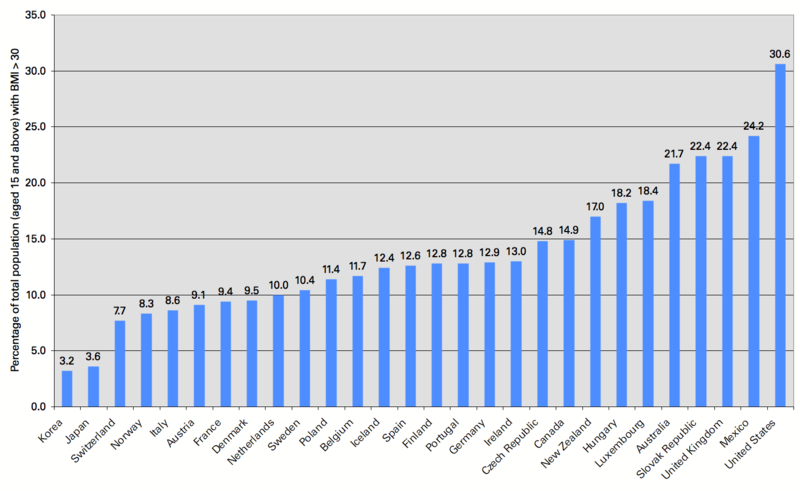
Here is a chart of the percentage obese people (by countries), defined as having an average body mass index (BMI) above 30:
The BMI estimates fat in your body by comparing your weight and height. It is calculated by dividing your weight  (in kilos) by the square of your height (in metres). It's easy to calculate your BMI online, just use one of the many websites available free of charge. Being myself at the upper limit of a healthy weight towards overweight, I vow to change that before the rich Christmas period comes up. 

I also vow to protect my lettuce patch from the tree lobbers who are coming tomorrow to make more space in our garden for food production and  especially more fruit trees. Only the big ficus in the middle of the garden is allowed to stay, but the top will be lobbed off too. Make sure the tree lobbers leave the mulch in place.

There is hope and a lot of motivation too. Better check on my barley now!


Monday, May 7, 2012

Chicken in the backyard?!

Chickens are a major link in a permaculture garden and I have been thinking about getting a chook coop for a while now. I have been admiring various constructions and found great blog posts such as these ones:
Special fascination for me have the mobile chicken co-ops and the genuine creativity people put in place when building such houses using what they have or find with the help of friends, verge collections or through initiatives such as freecycle. A great example of a mobile chicken coop is this one, using an old water tank on wheels.

Curious chicken at my mother's place
My garden is big enough, the right spot has been identified and cleared of jungle; and I even got some poles and chicken wire already organised. But so far I have been waiting to make the move and get the pen set up. The time is not quite right yet.

Also I have been turned off by the usual small size of chicken tractors, which is the name given to mobile chicken houses that people place on top of their garden beds to ensure the chickens eat pest, like slaters and snails, and leave their goodies as compost.

Today I saw a post on facebook that intrigued me and I am closer to devising what the final chook coop will look like. Check out this genuinely creative and sustainable construction by Matt Pike, described in the Farmer Pal's Forum.

Yesterday we went to the open day at the Lockridge Community Garden and a visit inspired us even more, especially an opportunity to look into the backyard of permaculture gardens in private hands in the vicinity of the relatively community garden.

Keep it up guys. And everybody who would like to get involved should check out PermacultureWest! Well worth connecting with.

Sunday, April 29, 2012

Food and Health

My good friend Annemarie sent me a picture this morning. It's too good to keep for myself:

I checked out their website, but could not easily spot this picture on it, check it out yourself if you like. This statement is probably not true at face value, as the importance of food gets more and more recognised. So I would replace the word 'no' with  'not very much'. But pointing out the lack of interaction between food and health industry is a very valid point which needs to be raised.

Finally the rainy season has started in Perth. We got a wooping 54mm on 28 April!  It poured down, a welcome breathing space for plants and soil biodiversity. I noticed that due to the humidity in the garden the sound levels especially at night time have risen significantly, lots of crickets and frogs. A real pleasure to watch and listen.

Despite a broken foot I have prepared pots for planting and sowed lettuces and herbs.  I pulled out huge stalks of sun flowers and will get the garden bed ready for beans. I also pruned some bougainvilleas and will have another go at propagating them, as the last attempt was unsuccessful. I noticed small roots starting already to grow out of some stems close to a leave. This season might be better.

Getting my hands dirty, turning the compost, emptying the worm farm and preparing the garden beds feels go good and right. I can't wait to go out in my garden again.

Sunday, March 11, 2012

Diversity in potatoes

I was intrigued by this photo showing potatoe varieties from Peru on a facebook group. I traced back the origin of the photo. It goes back to the CIP, the International Potatoe Centre  http://www.isgtw.org/feature/conserving-bio-diversity-perus-cip in Peru which seeks to ensure the genetic diversity of this staple food crop.

The picture comes with the following subtitle:

A few of the many varieties of potatoes. CIP maintains the world’s largest genetic bank of potatoes, including 1500 samples of 100 wild species collected in eight Latin American countries, as well as samples of 3800 traditional Andean cultivated potatoes. The collection is maintained under the auspices of the UN’s Food and Agricultural Organization, and is available to plant breeders worldwide free upon request.

Here are more pretty pictures about potatoes. Unfortunately in Western Australia the marketing of potatoes is limited through the Marketing Potatoes Act 1946. But the limitations in what kind of potatoes you can grow and sell in WA only apply to commercial producers. These are people who grow more than 100 square meters of potatoes. Luckily this is a lot bigger than my garden. Sadly the problem remains how to get the potatoes through quarantine. Also the Perth weather would probably not be suitable to grow any of these successfully anyway.

But they are so pretty!


Sunday, February 19, 2012

Preparing for autumn planting

New moon is tomorrow and the weather is already cooling down a bit especially at night time. Yesterday the daytime temperature was still 35 degrees, but I feel that autumn is around the corner. It's officially to start on 1 March here in Australia.

I have prepared three big pots for autumn planting and will check my local list of vegetable to grow. Am thinking about spring onions and leek, also am longing for a zucchini.

Currently there are only a few sunflowers that attract many bees. The beds are deserted apart from a few capsicums and tomatoes.

From a facebook list I got a good link to many recipes for canning fruit and vegetables. Looks very promising and makes the mouth water in the hope for a good winter harvest. the website contains recipes for jams, jellies and spreads, including some fruit butters and sauces referenced in the main alphabetical list below:
I will check it out, especially the relish.

I will have a vegetarian friend come over for lunch today. Just turned the breadmaker on to make me some nice pizza dough. On the menue is Pizza Bianca and some simple salads, including my Croatian inspired coleslaw.

My dough recipe is simple:
  • 1 cup water
  • 1/2 cup milk
  • 2 cups plain flour
  • 1 cup wholemeal flour
  • 1 teaspoon yeast and some salt
The breadmaker does the work and I sit back and I have time to do other things, eg writing this blog. Once the dough is ready I roll it out into three pizzas and let them rise for another hour of so.
My Pizza Bianca only has olive oil, mixed herbs, garlic, salt, mozarella and parmesan on it. One pizza is for lunch and the other two will be tonight's dinner. I will prebake their bases when I bake the lunch pizza and finish the pizzas up tonight. 

If you want to make it from scratch, this video helps. However, I rather use some wholemeal flour. Give it a go, it is as easy as it looks here:

Tuesday, February 14, 2012

Growing potatoes on top of lawn

Perth's climate is dry and hot in summer, but we have been getting good winter rains. The average rainfall in 2011 even topped the average rainfall mark by a few mm.

I am intrigued by this simple method of growing potatoes above ground, just on top of the lawn. I put it into my bucket list of methods to try.